
Swiss Post Cargo and Swiss Post Digital Services
This analysis is published as part of the dgdata sector atlas and reflects an independent structural reading based on public information only. It does not represent the position of any employer, shareholder, or affiliated entity. It applies the dgdata analytical framework, which distinguishes structural invariants from degrees of freedom for transformation.
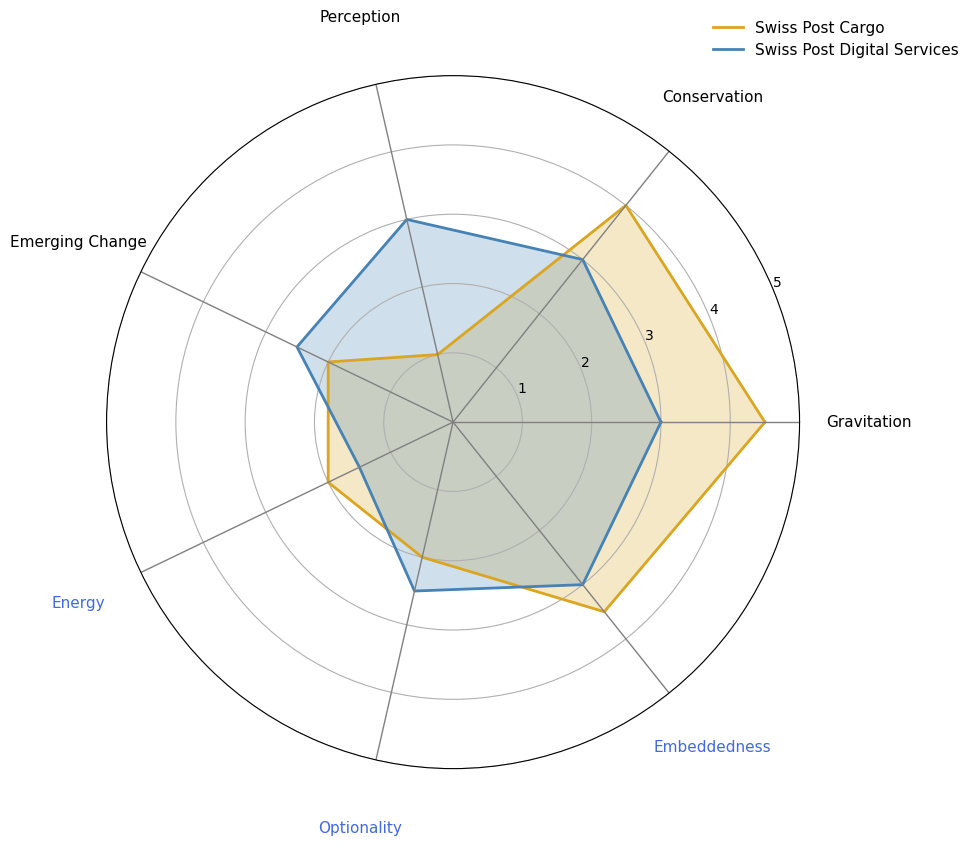
The spider map on the right provides a synthetic structural comparison between Swiss Post Cargo and Swiss Post Digital Services.
The table below details each invariant and constraint.
Transformation implications:
- Swiss Post Digital Services — priority on sharpening the strategic and institutional perception to reduce dispersion and clarify trajectory.
- Swiss Post Cargo — focus on efficiency, automation, and operational excellence; no digital transformation beyond execution enablement.
Different structures require different transformation logics.
| dgdata Lens | Swiss Post Cargo | Swiss Post Digital Services |
|---|---|---|
| Gravitation What holds the system together |
Strong, but derived – Clear center: operational reliability, physical network, delivery promise. – Gravitation inherited from the Group (infrastructure, brand, public-service mandate). – Execution-centered, not driven by an autonomous strategic intent. – Diagnosis: solid but secondary gravitation; Cargo orbits the Group core, it does not redefine it. |
Explicit, but unstable – Declared center: trust, security, digital sovereignty. – Multi-segment portfolio (enterprises, authorities, health), heterogeneous offerings. – Mission intellectually strong, but weakly embodied operationally. – Diagnosis: gravitation exists in discourse, not yet in traction. |
| Conservation What resists change |
Very high – Strong inertia of processes, professions, legacy IT, contractual logics. – Value comes from continuity, not disruption. – Diagnosis: conservation is functional; transformation must align with existing routines. |
Moderate, but institutional – Limited technical legacy compared to Cargo. – Strong regulatory, cultural, and political constraints linked to public trust. – Diagnosis: conservation stems from institutional role, not technology. |
| Perception Ability to read the environment |
Low – Mature market, stable signals (volumes, costs, SLAs). – No strong need for a strategic perception organ. – Diagnosis: low perception is not a flaw; this is a response system, not an anticipatory one. |
Structurally critical – Environment is volatile, regulated, technological, and competitive (Big Tech, GovTech, SaaS). – Without perception, the unit collapses into a solution catalogue. – Diagnosis: perception is the core invariant; without it, the system dissolves. |
| Emerging Change How change appears |
Slow, incremental – Continuous optimization through automation, standardization, IT integration. – No endogenous disruption. – Diagnosis: change is absorbed, never initiated. |
Discontinuous, fragile – Dependent on political decisions, alliances, regulatory windows. – Change is mostly exogenous, rarely organic. – Diagnosis: potential for rupture exists, but weak self-propagation. |
| Energy Capacity to fund transformation |
– Structurally constrained margins. – High capex, long ROI cycles. – Transformation as cost to absorb, not strategic lever. – Energy: low to medium, but stable. |
– Investments structurally required. – Uncertain returns, adoption-dependent. – Strong pressure for economic justification. – Energy: low, but directional (invested out of necessity). |
| Optionality Real strategic choice space |
– Very low optionality. – The network is the network; the business is the business. – Optionality: minimal and accepted. |
– High theoretical optionality, but constrained by sovereignty, public image, regulation. – Optionality: apparent, but tightly bounded. |
| Embeddedness Degree of systemic anchoring |
– High embeddedness in physical infrastructure and trade flows, not in national territory. – Structurally indispensable to the movement of goods, but highly substitutable at operator level. – Strong capital and network intensity, yet exposed to extreme price and service competition across borders. – Embeddedness: systemic necessity, but competitive prison. |
– Institutional rather than material embeddedness. – Strong legitimacy in Switzerland, weak international portability. – Embeddedness: asymmetric (strong locally, weak globally). |