
Three organisational architectures, three transformation logics
Why an invariants-based reading
An invariants-based approach provides a transversal analytical framework that makes it possible to compare very different organizations independently of their formal structures, organizational models, and prevailing reference frameworks.
Benchmark synthesis
This benchmark highlights three fundamentally distinct transformation logics.
In a territorial utility, transformation primarily aims to reduce systemic risk through clarification and discipline, with innovation mainly serving to secure and govern complexity.
In a hybrid player, the central challenge is to govern the long-term coexistence of incompatible regimes — regulated, market-based, and quasi-industrial — where data and digital capabilities act as instruments for arbitration and prioritization.
Finally, for a market-driven player, transformation mainly consists in strengthening an already sufficient market perception through automation, reliability, and decision speed, with any deep organizational transformation being largely redundant, or even counterproductive.
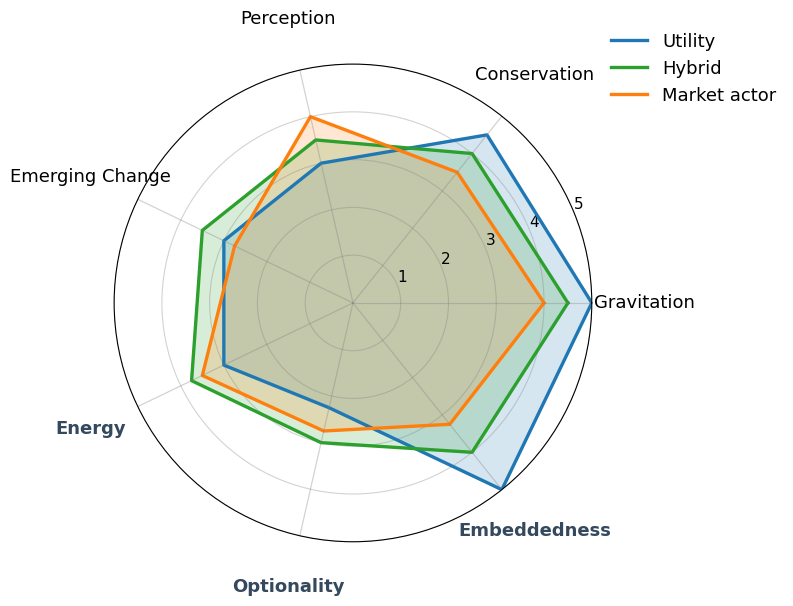
| Invariant | Market Player | Hybrid Player | Territorial Utility |
|---|---|---|---|
| Gravitation | High but non-societal. Economic value creation, financial performance, and market risk control. | High gravitation, predominantly economic. Less political than a Territorial Utility, but more composite than a pure market player. | Maximum gravitation, driven by an explicit public mission. Composite: security of supply, sustainability, public service, energy transition. |
| Conservation | Medium to high: heavy but arbitrable assets, industrial culture, operational excellence. | Strong, but partially offset by sectoral and organizational diversification. | Very strong: regional legacy, critical infrastructures, regulation, public service identity. |
| Perception | Strong but controlled: regulation integrated into economic models. Structured reading of market dynamics and constraints. | Distributed perception: group-level ability to read multiple regimes simultaneously (market, regulation, territories). | Extreme: cantonal politics, citizen expectations, multi-level regulation. Perception imbalance: very strong institutional and operational perception, more constrained strategic perception. |
| Emerging Change | Channeled: accepted if it reinforces efficiency, resilience, or competitiveness. | Governed: change accepted only if compatible with the long-term coexistence of heterogeneous logics. Transformation = arbitration, integration, and tension management. | Necessary but risky: imposed transition, innovation under close scrutiny. Transformation oriented toward clarification, discipline, and prioritization rather than rupture. |
| Degree of Freedom | Market Player | Hybrid Player | Territorial Utility |
|---|---|---|---|
| Energy | Solid financial and technical capacity. Available managerial bandwidth to optimize and automate. | Real managerial energy but fragmented across entities and business lines. Requires strong orchestration to avoid dispersion. | Real but constrained energy. Permanent trade-offs between operations, transition, politics, and finance. |
| Optionality | Options already largely arbitrated. Few credible new strategic trajectories. Transformation = incremental improvement. | Real optionality through internal arbitration, activity portfolio, and multi-logic organization. | Optionality mainly organizational and partnership-based. Few rupture options, but critical sequential choices. |
| Embeddedness | Lower embeddedness: direct exposure to the market. Regulation integrated into economic models, limited direct political exposure. | Still strong embeddedness, but less constraining than for a pure utility. Partial decoupling capacity. | Extreme embeddedness: political, territorial, and societal. Every decision engages public legitimacy, with low implicit reversibility. |