
How organizations move — without breaking themselves
This diagram describes how transformation actually works in real organizations —
not as a linear project, but as a system of distinct loops with different purposes, leadership profiles, and specific risks.
Most transformations fail not because of a lack of effort or technology,
but because these loops are confused, collapsed into one another, or owned by the wrong roles.
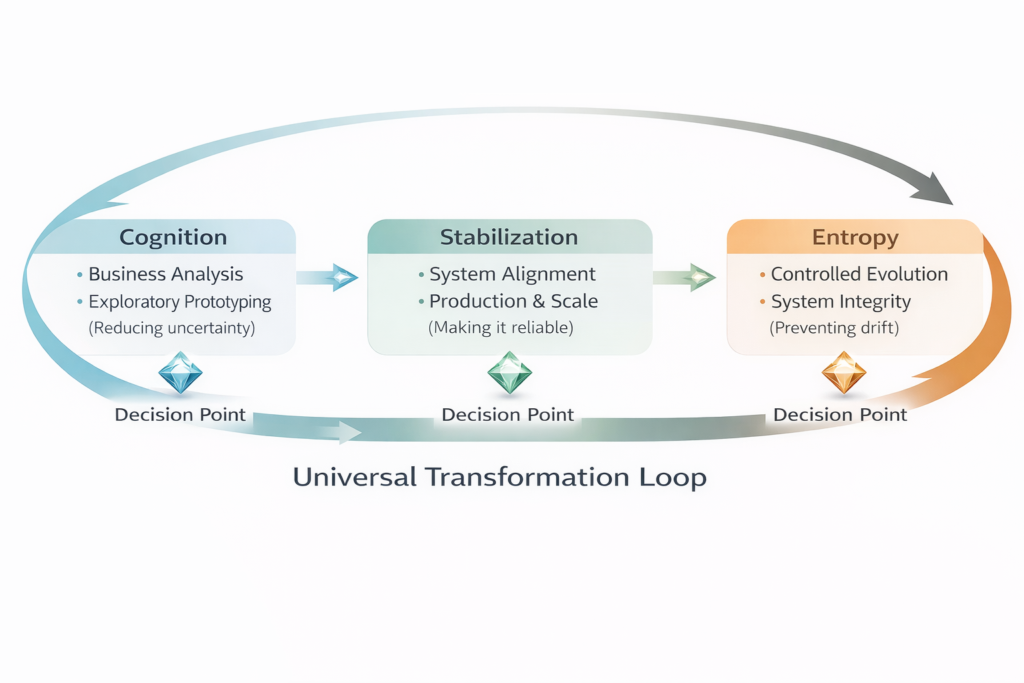
A Core dgdata Insight
Transformation fails when organizations:
- collapse these loops into a single “delivery process”, or
- assign them to profiles not designed to lead them.
Each loop serves a different systemic function:
- cognition,
- stabilization,
- integrity over time.
Confusing them leads to predictable failure patterns.
Decision Points and Non-Go Zones
Every transformation chain must include explicit decision points.
Not to slow down transformation —
but to prevent irreversible mistakes.
At each decision point, the organization must consciously decide:
- whether uncertainty has been sufficiently reduced,
- whether the system is ready to commit,
- whether change signals are local or structural.
dgdata principle
Every transformation chain must include explicit non-go zones.
Transformation is not about doing more.
It is also about knowing when not to proceed.