
Who intervenes where — and what must never be delegated
1. Core dgdata principle
A successful digital transformation does not depend on piling up profiles,
but on the correct attribution of leadership across the phases of the Universal Transformation Chain,
and on the strict respect of what cannot be delegated without loss of meaning, traction, or durability.
Transformations rarely fail because of a lack of competencies.
They fail because the wrong competencies take the lead at the wrong moment — or because what could not be delegated was.
2. Direction & leadership
C-Level Sponsor (Executive Committee member)
A serious sponsor is neither a passive supporter nor an IT relay.
They are a carrier of organizational continuity.
Transformation Lead
The transformation lead is an architect of transition, not an extended project manager.
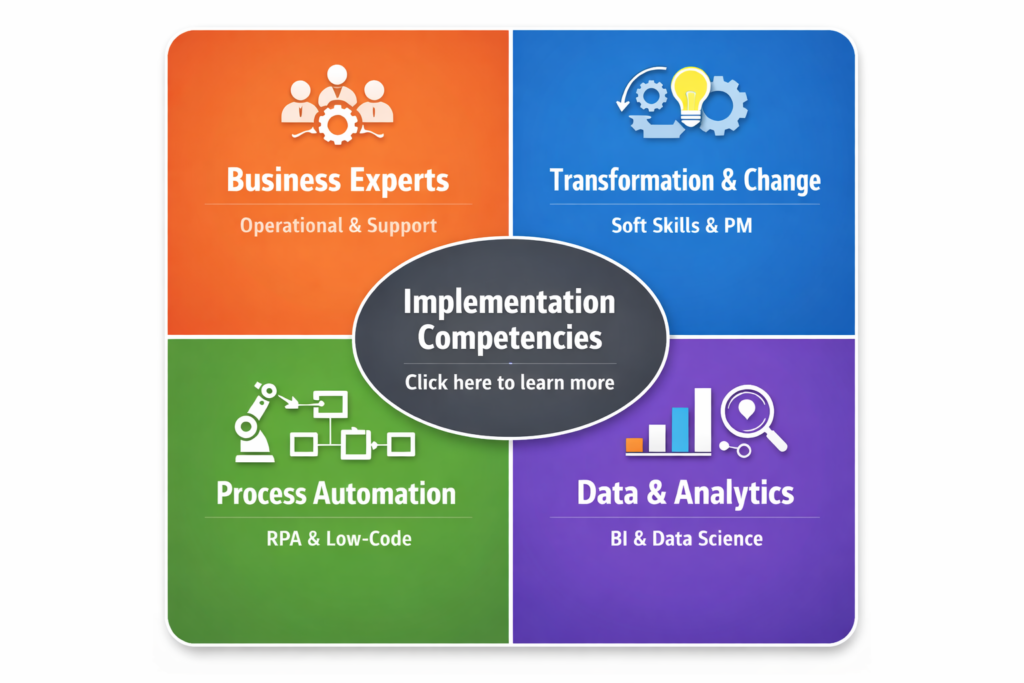
3. Team & implementation — the four families of competencies
4. dgdata specificity — leadership allocation by phase
| Transformation Phase | Primary lead | Co-actors |
|---|---|---|
| Cognition / Prototype | Business experts + technical experts | Data / automation |
| Stabilization / Production | Transformation + traditional IT | Business |
| Entropy management | Business & domain experts | Technical support |
5. Re-valuing non-technical profiles
dgdata principle
Automation reduces headcount,
but radically raises the level required of those who remain.
Key post-digitalization profiles are:
- process experts,
- capable of interacting with:
- technical experts,
- transformation profiles,
- without being technical specialists themselves.
These are rare profiles, not remnants of the past.
6. Hybrid processes — no profile supremacy
There is no such thing as a “purely digital process.”
There are only hybrid processes.
- Business expertise without tech → inefficiency
- Technical expertise without business → no real use case
Principle of non-substitution (dgdata cornerstone)
Technology never replaces business expertise.
It stabilizes, extends, or accelerates it.
7. Orthogonal modes of cognition — sovereignty without silos
| Business functions | Technology & AI |
| – situated knowledge – slow accumulation – deep domain constraints | – abstract and composable – fast learning cycles – continuous recombination |
The dgdata framework does not seek to merge these cognitions.
It grants each:
- a clear zone of sovereignty,
- an explicit scope,
- a legible and transparent articulation of collaboration.
No silos.
No confusion.
No domination of one mode over the other.