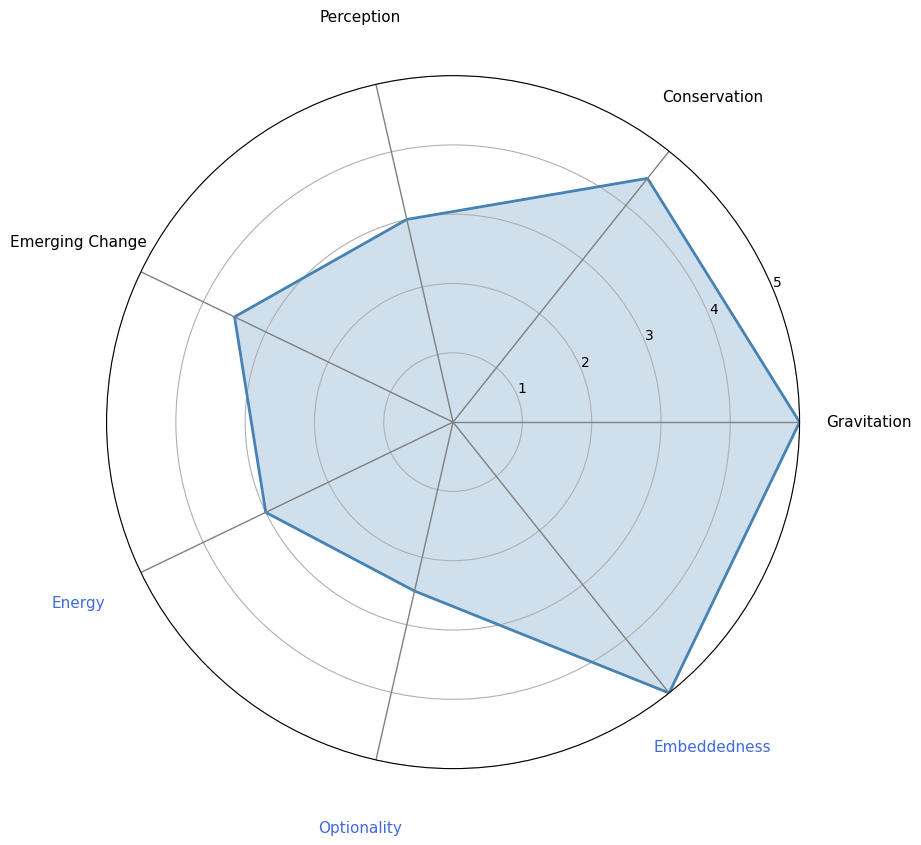
Energy — Structural Invariants
The Energy sector exhibits maximal gravitation and embeddedness, reflecting its foundational role in economic stability, national sovereignty, and societal continuity. Energy systems are deeply anchored in public interest, regulatory oversight, and geopolitical considerations, elevating gravitation to the highest level among industrial sectors.
Conservation is correspondingly high, driven by capital-intensive infrastructures, long asset lifecycles, and governance frameworks optimized for reliability and risk avoidance rather than rapid adaptation.
Emerging change is significant but constrained. The energy transition introduces real structural movement—decarbonization, electrification, and decentralization—yet this change unfolds under strict regulatory, political, and operational boundaries. As a result, transformation is incremental and cumulative rather than disruptive.
Perception within the sector is unevenly distributed. Institutional and operational perception are highly developed, while strategic perception remains fragmented, often pulled between long-term transition goals and short-term stability imperatives.
This configuration produces a sector with high structural depth, limited optionality, and moderate strategic energy: capable of transformation, but only within narrowly defined corridors shaped by regulation, infrastructure, and societal expectation.
How to read and use the Spider Chart